

 Italiano IT
 English EN
 Français FR

Fifteen years
inside the factory.
We saw Industry 4.0 take shape, we are working through 5.0 and today we are living the artificial intelligence revolution. Every step has taught us the same thing: technologies change, but the process is still where you start.
About us
You can only improve a process after you have seen it running. That is why we start from the shop floor: shift changes, set-ups, picking, stocktakes, orders stuck between one department and the next. The software comes later, and it is the right one.
Every factory we have digitalised has left us something: a flow to simplify, a figure nobody was measuring, a habit to change. This is the experience we bring to every new project, from the first site visit to go-live.
Three revolutions,
one common thread.
We have lived through them from the inside, project after project. Each one added a tool; none changed the starting point.
The beginnings
Bringing data onto the shop floor
Where the ERP stopped, there was paper, Excel spreadsheets and word of mouth. That is where we started: giving production and the warehouse the tools the ERP did not have. In 2015 this experience became Logikamente, an innovative start-up.
Industry 4.0
Connecting
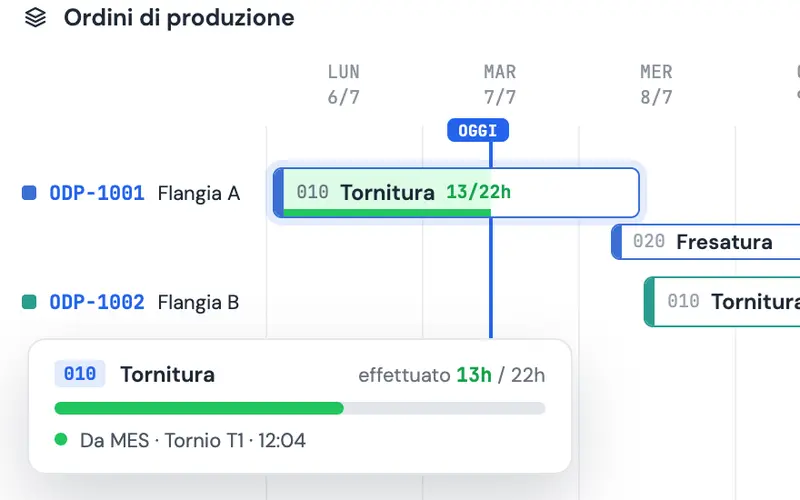
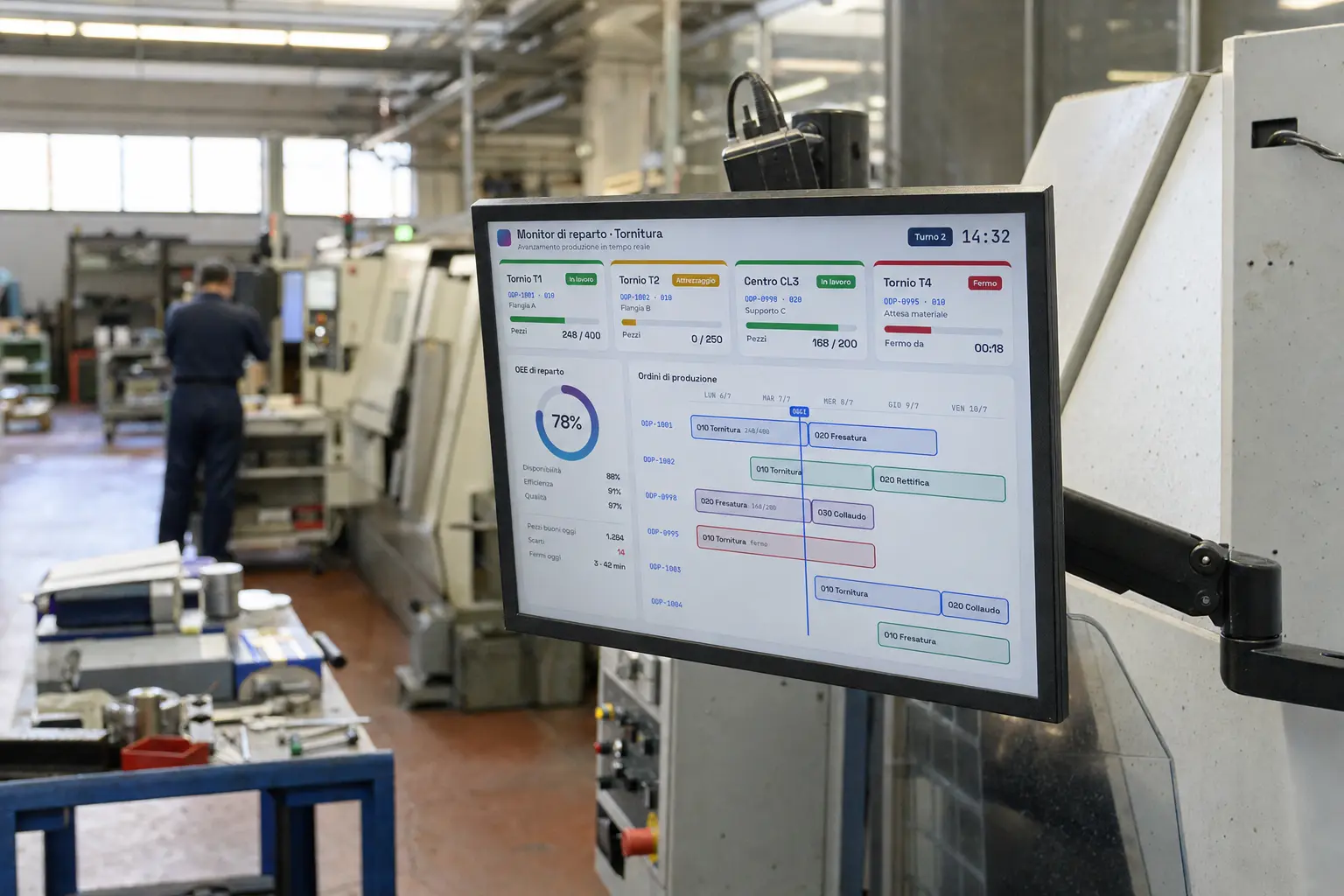
Connected machines, real-time production tracking, certified solutions eligible for incentives. Data comes from the field, no longer from someone's memory.
Industry 5.0
Putting people back at the centre
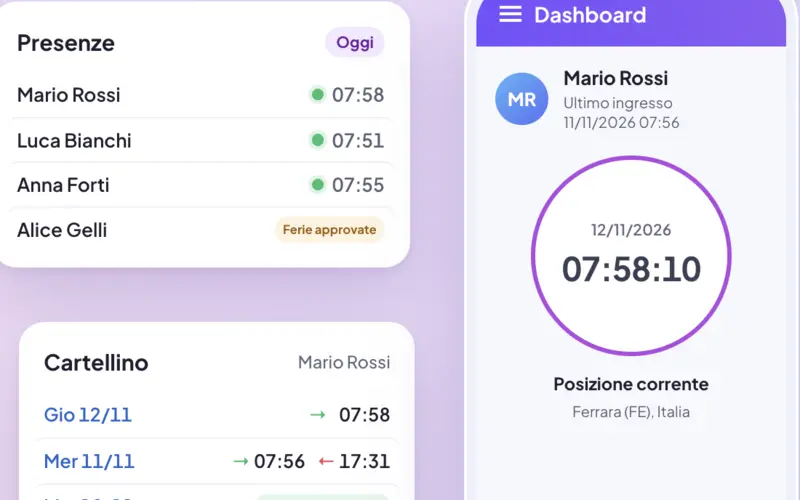
Time and methods, attendance, ergonomics, sustainability. People's work becomes part of the process again, not a variable to squeeze.
Today · AI
Giving the process intelligence
Artificial intelligence is entering the factory: it reads documents, analyses data, keeps company know-how and gives it back. It is our next challenge, and it has already begun.
The Logikamente method
Five phases.
Always the same.
Whether it is a warehouse, an assembly line or a paint shop, the path does not change. The answers do, because every factory is different.
Start with phase 01-
01
Observe
The shop floor comes first.
We go where the work is done. We follow the real flow of materials, people and information, from goods-in to shipping, together with the people who live it every day.
What you getA map of the current flow, with waste, waiting times and bottlenecks highlighted. -
02
Measure
A number is worth more than an opinion.
We choose a few clear indicators (production progress, times, stock, OEE) and capture the starting point. From then on, every choice is judged on the data.
What you getA shared baseline against which every improvement is measured. -
03
Redesign
Process before tools.
With your team we design the future process: fewer manual steps, less waiting, clear responsibilities. Only then do we decide which tools are needed.
What you getThe future process and an action plan ranked by priority and impact. -
04
Digitalise
The right tool, not one more.
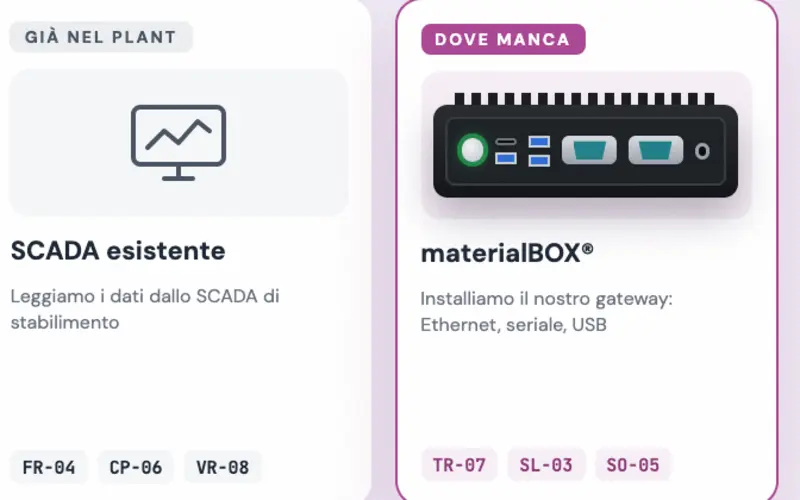
We integrate the systems you already have and, where something is missing, we bring our own: MES, WMS, machine data collection, attendance, artificial intelligence.
What you getA single data flow, from the ERP to the machine. -
05
Improve
The project ends; improvement doesn't.
We monitor results, support people and set new goals. Then the cycle starts again, one step further each time.
What you getAn organisation that can measure itself and keep improving on its own, over time.
Our vision
Bringing artificial intelligence
to where things are made.
Not a generic AI, but an intelligence that knows your processes, works on your data and stays inside your systems. For us it is the natural next step after fifteen years spent making the factory measurable.
-
Process automation
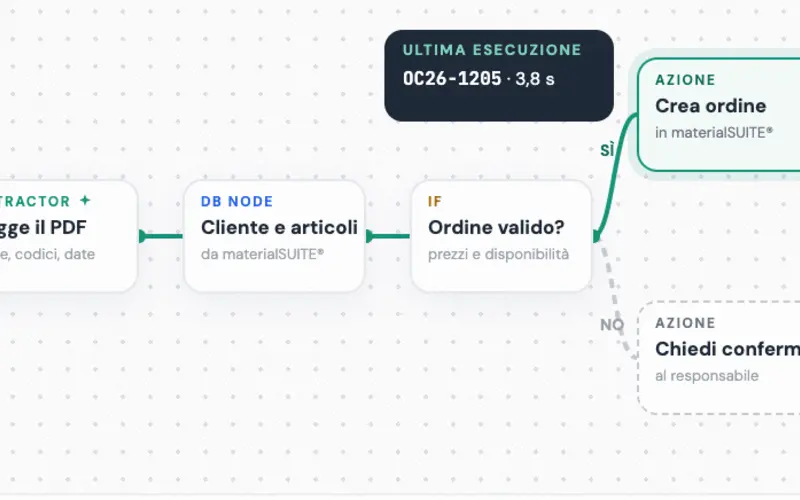
Orders, delivery notes, paperwork and forms read, checked and recorded automatically. People deal with the exceptions, not with copying data.
-
Data analysis
From shop-floor data to decisions: anomalies spotted before they become problems, clear priorities, forecasts of times and workloads.
-
Private knowledge
Procedures, work instructions and shop-floor experience can be queried in natural language, without company know-how ever leaving the company.
The people you will meet
A method is only as good as the people who apply it. They are the ones who come to the shop floor, listen, measure and follow the project through to results.
-
 Pre-sales Consultant
Giacomo Minichiello
Needs analysis and choice of tools
He is often the first person you meet when you get in touch with us. His job is to listen: to understand how the company works, where time is lost, and what the people on the shop floor and in the office need. From there he helps choose the digital tools that fit the process, without adding anything that isn't needed.
Articles by GiacomoBefore we talk about software, I ask you to walk me through a working day.
-
 Project Manager
Denise Lipparini
Production tracking, MES, time collection and scheduling
A mathematician by training, she started out as a software developer and then specialised in operations management. At Logikamente for more than ten years, she leads projects on production tracking, MES, time collection and scheduling: she knows the shop floor and knows how to turn it into a system people actually use.
A production plan is only as good as the data it starts from.
-
 Project Manager
Jacopo Melchiorri
Intralogistics, logistics and warehouse
A computer scientist by training, he has long experience managing projects for manufacturing companies. He works on intralogistics in support of production, on logistics and on the warehouse: the right material, in the right place, when the line needs it. He also looks after cybersecurity applied to industrial automation.
A warehouse works when the line never has to stop and wait for it.
-
 CEO & Founder
Stefano Ciammarughi
Strategy, data and artificial intelligence
He founded Logikamente after years spent bringing data onto the shop floor. He works on machine learning and artificial intelligence applied to operations, and teaches Data Organization and Machine Learning at the University of Ferrara.
Artificial intelligence works when it starts from a process you know well.
The method also applies to the data you entrust to us.
Every day we work with our customers' production, warehouse and personnel data. That is why data processing, operating procedures for development and support, information security and cybersecurity are not a separate chapter: they are written rules that we follow in every project and check over time.
- 15years inside the factory
- 100+operations projects
- 60+plants digitalised
- 100+machines connected
How to get started
No leap in the dark: we start small, in one department, and grow on the results.
- 1
A conversation
You tell us how your factory works today and where you feel the problem is.
- 2
A shop-floor visit
We observe the flow in person and collect the first data.
- 3
A proposal by priority
What to do first, with what expected impact and which tools.
- 4
A pilot project
We start with one department, measure the results, then extend.
Fifteen years of factories,
at the service of yours.
The first step is a conversation. The second, a visit to your shop floor.
Let's talk about your process