 Italiano IT
 English EN
 Français FR

What AI in manufacturing is and how it is transforming business processes
Artificial intelligence applied to production is taking on an increasingly strategic role in operational and decision-making processes. The evolution of AI in the manufacturing industry is no longer just about predictive models built on historical production data, but about the ability to interact with the company’s information infrastructure, support decisions distributed along the entire value chain and speed up the digital transformation of manufacturing.
In most manufacturing companies, complexity does not lie solely in shop-floor activities, but in the fragmentation of information systems. ERP, MES, WMS, SCH and document management systems often operate as separate silos, creating misalignments between technical data, commercial data and the actual state of production. This translates into non-value-adding activities: searching for information, realigning data by hand, dealing with inconsistent document versions and constant back-and-forth between departments.
In this context, AI in manufacturing is not introduced as yet another vertical system, but as a cross-cutting layer for accessing and interpreting company data. Its main function becomes reducing the information latency between an operational event and the resulting decision, supporting a smart factory model in which data, people and processes work together in an increasingly integrated way. So it is not about automating production in the strict sense, but about compressing the time needed to turn available data into consistent operational actions.
Agentic AI in manufacturing: a new resource for company teams
Agentic AI is one of the most significant developments in industrial AI. These are software systems able to pursue an operational goal by breaking it down into a sequence of activities, interacting with business tools, data and applications to carry out or support complex workflows.
Unlike a traditional conversational model, which simply answers individual requests, an agentic AI works with a process logic. It receives a high-level input (for example a sales enquiry, a non-conformity or a planning need), interprets the context, retrieves the information it needs from company systems and structures a response that may include analysis, summaries or operational actions.
In manufacturing, this means working directly at the intersection between information systems and decision-making processes. An agentic AI can query an ERP to check material availability, access a PLM to retrieve technical specifications, consult a document management system to identify the applicable procedures and correlate this information with production constraints in the MES or APS systems.
The value does not lie in the single answer, but in the ability to orchestrate information flows that today require multiple manual interventions across departments. In this sense, agentic AI becomes an execution and coordination layer on top of the existing application architecture, with controlled levels of autonomy and defined governance.
The benefits of agentic AI for manufacturing and industrial operations
Adopting AI in manufacturing through agentic AI platforms has measurable effects, above all on indicators related to time, data quality and the efficiency of industrial operations.
The first benefit is a shorter flow time for information between company functions. Activities such as handling a customer request, checking technical feasibility or preparing a commercial response typically involve several systems and several departments. Agentic AI reduces the number of manual steps needed to get a complete picture, cutting waiting and coordination times.
A second element concerns the consistency of the data used in decision-making. In many manufacturing companies, operational decisions are made on information that is partial or not perfectly aligned between systems. Working as an aggregation layer, AI makes it possible to consolidate data from different sources and reduce discrepancies between departments.
A further advantage is the reduction of low-value activities. Searching for technical documentation, checking product codes, version control and manually extracting data from ERP or legacy systems account for a significant share of operating time in engineering offices, production and the supply chain. Intelligent automation of these activities frees up resources without directly touching physical processes.
Finally, agentic AI improves the scalability of information processes. As production complexity, the number of variants and the markets served increase, handling information manually becomes a limiting factor. An agentic system makes it possible to keep the level of information service stable even in growth scenarios.
How to implement agentic AI in manufacturing
Implementing agentic AI in manufacturing should be approached as a project to transform information processes and digital manufacturing, not as a simple technology roll-out.
The first step is to map the processes characterised by high information intensity and highly fragmented systems. Typically these are order-to-delivery processes, quotation management, non-conformity management, technical support, production planning and operations.
Next, the existing application ecosystem needs to be analysed. ERP, MES, PLM, CRM and document management systems must be seen not as isolated tools, but as data sources and systems of action that the agentic AI will have to orchestrate. The quality of the integrations and the availability of APIs or connectors are a fundamental enabling factor.
A key element is defining the system’s scope of autonomy. In industrial settings, full decision-making autonomy is not realistic. AI has to work on a human-in-the-loop basis, suggesting, preparing or automating activities in line with the business rules and authorisation levels set by the company.
The most effective approach is incremental: start from a well-defined domain, measure KPIs such as processing times, error reduction and productivity, and then gradually extend the platform to other business processes.
How AI in manufacturing reduces order lead time
One of the main goals of AI in manufacturing is to reduce the overall lead time of an order. In most manufacturing companies, a large share of the time is not determined by machining or processing, but by waiting for information, hand-offs between departments and administrative tasks.
Applying agentic AI to these processes reduces the time between a request being generated and its operational execution, removing information bottlenecks and making decisions available sooner.
In this scenario, solutions such as donia act as an application layer able to orchestrate specific processes along the entire order-to-delivery chain, from quotation and order data entry through to fulfilling the order from the warehouse.
donia: the AI platform for the manufacturing industry
donia is an Industrial Agentic AI platform designed specifically to apply AI in manufacturing, acting on the information and operational processes that directly affect lead time, production efficiency and the company’s competitiveness.
Unlike generic AI solutions or corporate chatbots, donia is designed to optimise industrial operations through integration with ERP, MES, WMS, schedulers, CRM and document management systems.
The aim is not to replace the systems already in place, but to make more of them, making them accessible, queryable and actionable through agentic logic. The platform turns fragmented information flows into structured processes, reducing search times, manual steps and repetitive tasks.
donia sales: agentic AI for generating quotations from technical documentation
Quoting is one of the most complex processes in manufacturing, especially when it requires analysing tender specifications, technical specifications, customer requests and project documentation.
donia sales applies artificial intelligence to production by automatically analysing technical documentation, extracting the customer’s requirements and retrieving the necessary information from company systems. The result is faster, more standardised and more consistent quotation, with a significant reduction in the lead time of the sales phase.
donia document: agentic AI to automate order data entry into the ERP
In manufacturing companies, a significant part of administrative time is still spent manually transferring customer orders from PDFs into the ERP.
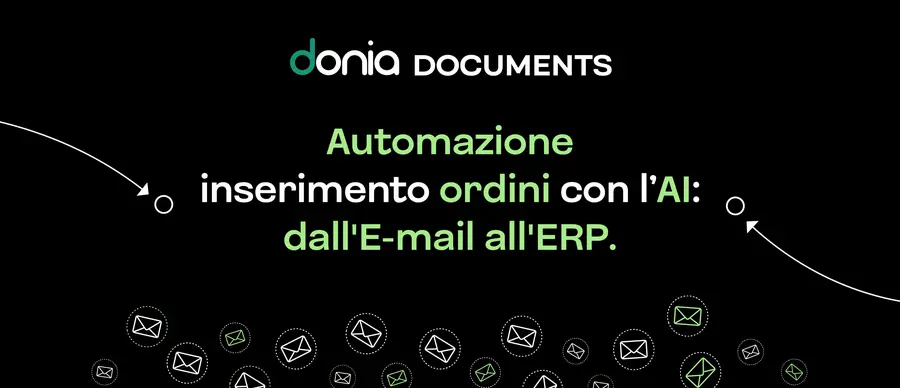
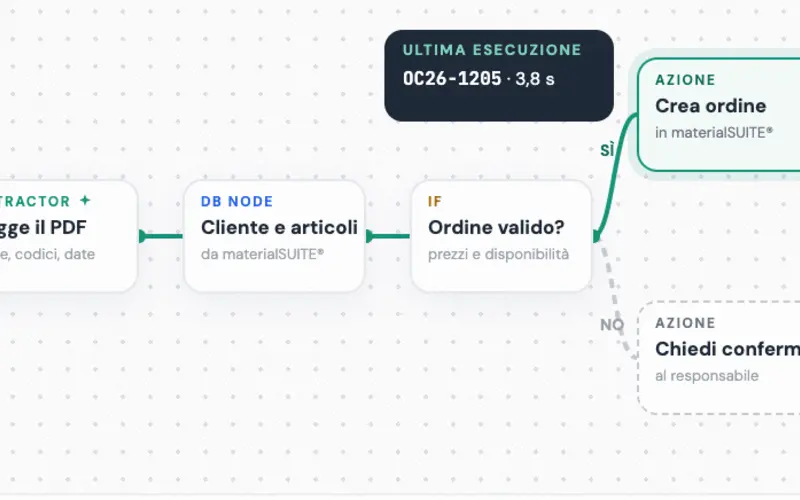
donia document uses AI in manufacturing to monitor the mailbox, capture incoming orders, interpret their content and automatically prepare the order entry. The operator simply has to check the data and export it to the ERP, shifting their role from plain data entry to checking and handling exceptions.
donia operations: agentic AI to optimise production and logistics
Industrial operations rely every day on MES, WMS and scheduling systems to manage production, logistics and planning.
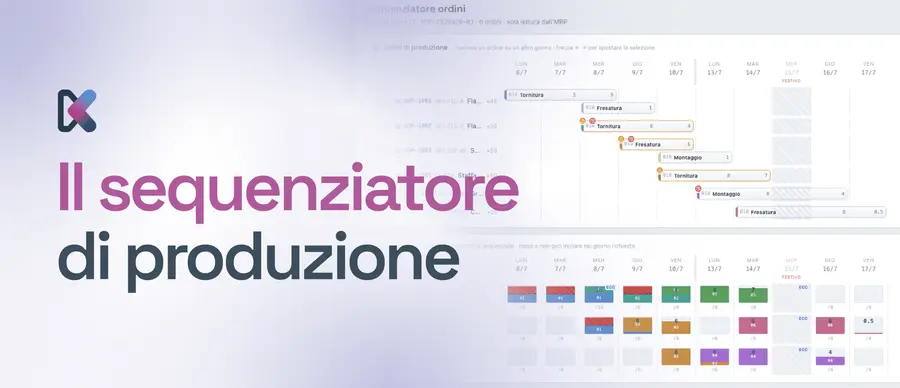
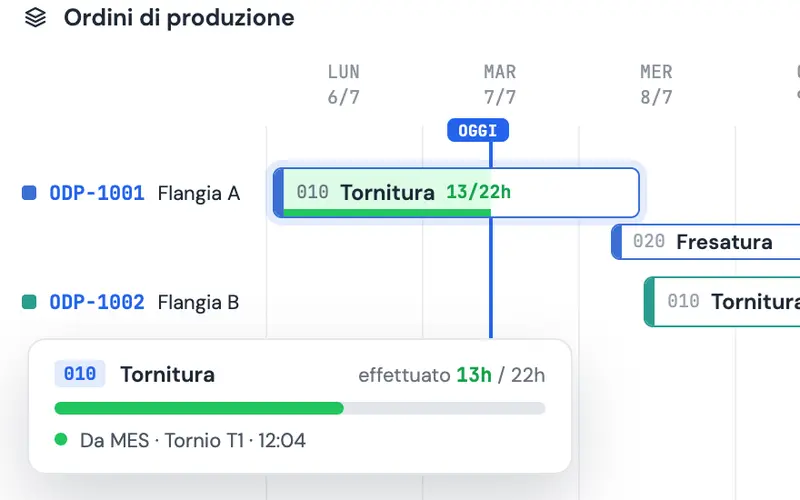
donia operations applies AI in manufacturing by working alongside factory software, retrieving and correlating the data needed to support operational activities. The platform simplifies access to information, improves coordination between production, logistics and planning, and lets operators spend more time on decisions and less on looking for data.

He is often the first person you meet when you get in touch with us. His job is to listen: to understand how the company works, where time is lost, and what the people on the shop floor and in the office need. From there he helps choose the digital tools that fit the process, without adding anything that isn't needed.