
 Italiano IT
 English EN
 Français FR

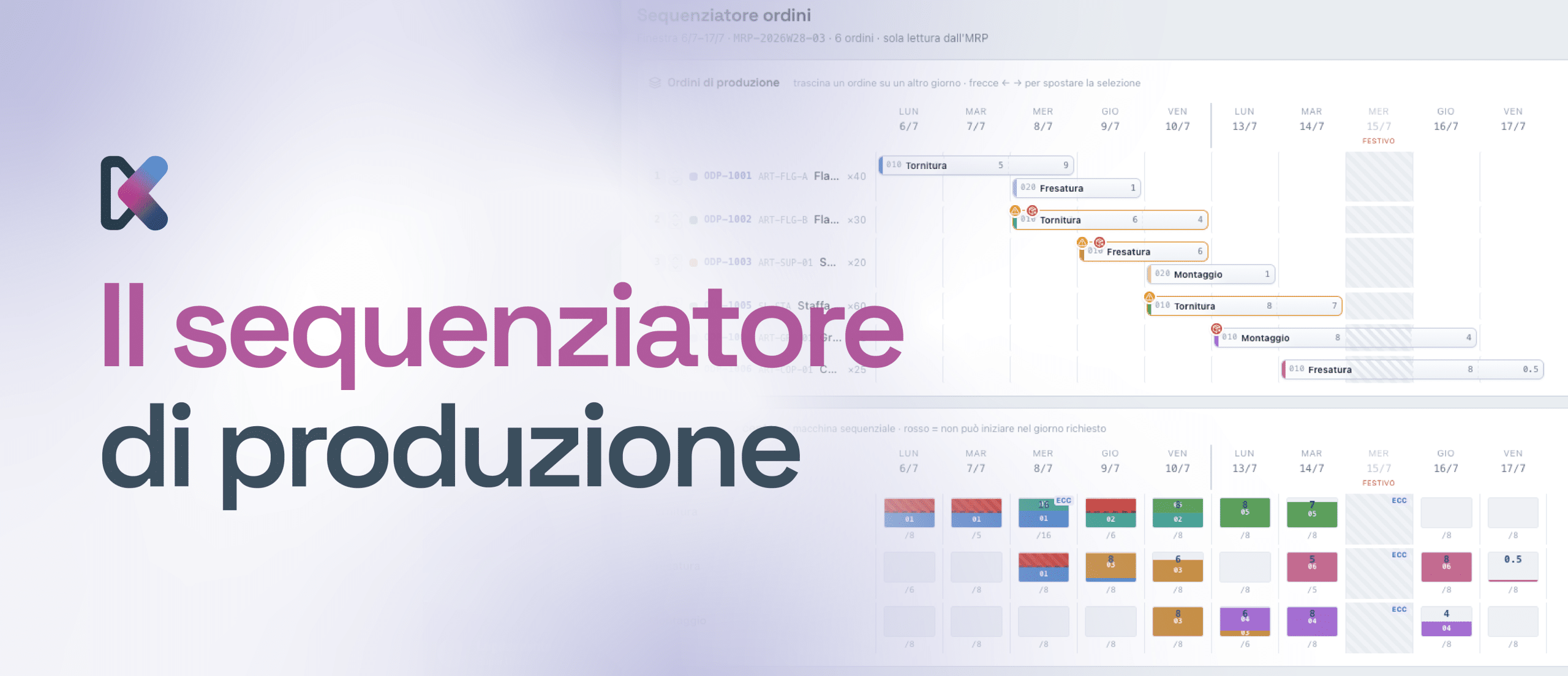
Production sequencer: what it is, how it works and when you need a scheduler
A production sequencer is the tool that decides the order in which production orders are run on each machine, line or work centre. It starts from the plan already in place and decides the execution sequence, taking into account due dates, priorities, processing times and resource availability.
It is the most operational part of production planning, and often the least controlled: the weekly plan exists, but the order in which jobs go through the machine is decided every morning by the shop-floor supervisor, from memory.
What is a production sequencer
A production sequencer answers a precise question: given a set of orders already assigned to a resource, in what order should they be processed?
The question seems trivial as long as there are only a few orders. With four orders on one machine there are 24 possible sequences. With ten orders there are more than 3.6 million. No planner evaluates them all: they choose a reasonable sequence based on experience, and the result depends on who is on shift.
The sequencer replaces this implicit choice with explicit, repeatable logic: a priority rule, an optimisation criterion or a combination of the two, applied in the same way to every order. The result is a production sequence that can be checked, explained and improved over time.
Planning, scheduling and sequencing: the differences
Planning, scheduling and sequencing are often used as synonyms, but they describe three different levels of production planning.
Planning works over horizons of weeks or months and decides what to produce and in what quantity. It is the level of MRP and the master production schedule, which turns customer orders and forecasts into production orders and material requirements.
Scheduling places orders in time and on resources. It decides on which machine and when each operation will be carried out, checking that the available capacity is sufficient. It is the level of APS (Advanced Planning and Scheduling) schedulers.
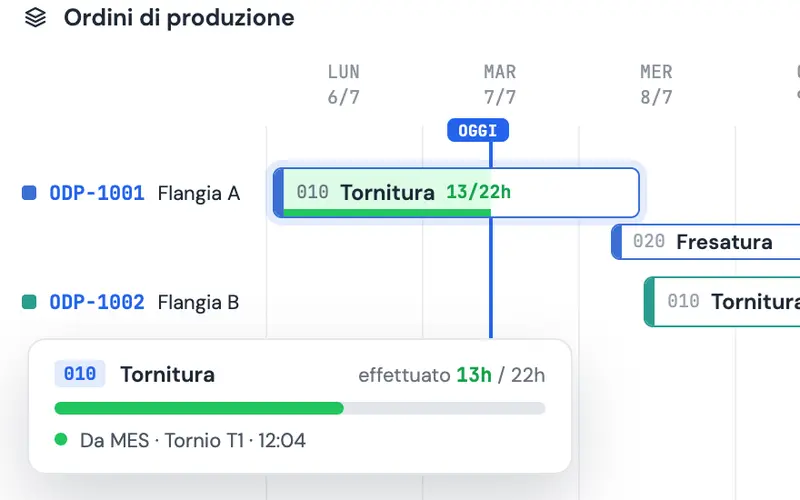
Sequencing is the finest level: on a resource that has already been assigned, it decides the order in which to run the jobs. It is the sequence that reaches the shop floor and that the operator finds on the terminal of the MES software.
The practical difference is that a pure sequencer does not move jobs from one machine to another and does not check upstream constraints: it reorders what it finds in the queue. A production scheduler also does the sequencing, but within a broader calculation that takes capacity, materials and labour into account.
What problems production sequencing solves
The wrong order does not change the amount of work to be done, but it does change when each job finishes. The most common consequences of an uncontrolled sequence are:
- late deliveries even when overall capacity was sufficient, because an urgent order was left in the queue behind less critical jobs;
- constant rush jobs, with work interrupted and restarted to push through the order of the customer who chased it;
- machines waiting for material, when an order is started whose components are not yet available in the warehouse;
- idle resources because the sequence does not take into account shifts or the operators qualified on that machine;
- high WIP, with semi-finished goods piling up between one stage of the production cycle and the next because the departments’ sequences are not coordinated.
What are the sequencing rules
Sequencing rules, also known as dispatching rules, are the criteria a production sequencer uses to order the jobs in the queue. They are simple and have been studied for decades in scheduling theory. Each one optimises a different objective: none is the best in absolute terms.
FIFO (First In, First Out): orders are processed in the order they arrive. It is perceived as fair and is easy to explain, but it completely ignores due dates.
EDD (Earliest Due Date): the order with the nearest delivery date is processed first. On a single machine it minimises maximum lateness, a result proved by J. R. Jackson in 1955. It is the natural choice when the priority is on-time delivery.
SPT (Shortest Processing Time): the shortest order is processed first. On a single machine it minimises average completion time and reduces the average number of jobs in the queue, and therefore WIP. However, it risks leaving the longest orders waiting for a long time.
Critical ratio (CR): you calculate the ratio between the time remaining until the due date and the remaining processing time. A value below 1 flags an order that, without intervention, will be late. It is a dynamic rule, recalculated at every progress update.
Assigned priority: the sequence follows a priority level set by the company: strategic customer, margin, contractual penalties.
In practice the rules are combined: for example EDD as the main criterion and SPT to break ties.
How to choose the sequencing rule
The right rule is chosen starting from the objective, not from habit. A five-step method:
- Define the department’s main objective: on-time delivery, lower WIP, resource utilisation or fewer setups.
- Check the quality of the data: cycle times, setups and delivery dates must be reliable, otherwise any rule will produce wrong sequences.
- Choose the rule that fits the objective: EDD for on-time delivery, SPT for throughput time, campaigns by product family where setups depend on the sequence.
- Simulate the rule on real data from a few weeks and compare the results with the current sequence.
- Measure after go-live with the KPIs listed below and review the rule if the objective changes.
Sequence-dependent setups and heijunka levelling
In some processes the setup time is not fixed, but depends on the previous job. In plastic moulding, switching from a light colour to a dark one requires little purging, while the reverse requires a full clean. In food production, a product containing allergens must be followed by sanitisation that is not needed in the opposite direction.
In these cases sequencing also affects total time, not just on-time delivery. Companies use campaigns by product family and changeover rules (light→dark, allergen-free→with allergens) to reduce the most costly changeovers. Where setup times are instead defined in the production routing for each operation, their value is known in advance and sequencing works on due dates, priorities and resource availability.
On lean-inspired assembly lines, sequencing takes another form: heijunka, or production levelling. Instead of producing large batches of one model at a time, the sequence alternates models in small batches, according to a constant mix. The result is a more even load for the line and for suppliers, at the cost of more changeovers.
Production sequencer or scheduler: which do you need
A production sequencer is enough when each order is already assigned to a single machine, materials are normally available and the main problem is deciding the order of the queue. This is typical of departments with a few independent resources and single-operation cycles.
You need a scheduler when:
- orders go through several operations on different resources, and the sequence in one department affects the sequence in the next;
- an order can be processed on several alternative machines and you have to choose where;
- the availability of materials and components must be checked before starting work;
- labour is a constraint, with shifts and operators qualified only on certain resources;
- the sales office needs a reliable delivery date as early as the quotation stage.
In these scenarios the difference between a scheduler and a sequencer becomes tangible: optimising the sequence of each machine separately is not enough, because an optimal sequence on one resource can create waiting time on the next.
The most common sequencing mistakes
- Sequence decided from memory: the logic exists only in the supervisor’s head: it cannot be checked and does not survive an absence.
- Priorities changed by word of mouth: urgent jobs are communicated on the shop floor without updating the plan, which stops being reliable.
- Orders started without material: the sequence is followed, but the machine stops while waiting for components.
- One rule for everything: FIFO applied everywhere, even where on-time delivery matters more than order of arrival.
- No feedback from the shop floor: the plan is not updated with actual production progress, and after a few hours it describes a situation that no longer exists.
- Outdated cycle times: if standard times are far from reality, any sequence calculated on them is wrong from the start.
How materialSUITE® handles sequencing
In the materialSUITE® SCH module, production sequencing is part of a broader scheduling calculation based on heuristic algorithms.
The scheduler orders jobs taking into account priorities, delivery dates and the times defined in the production routing, including the setups for each operation. It works at finite capacity, spreading the load across lines, departments and resources, or backwards from the delivery date, to calculate when each operation must start.
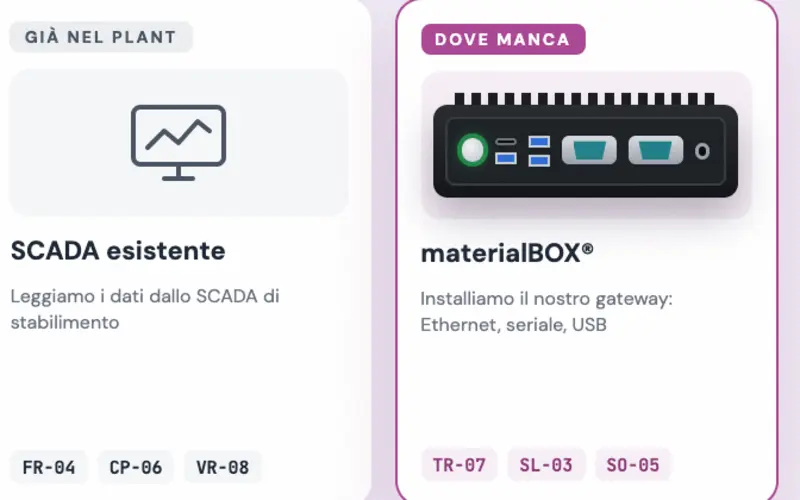
Integration with the WMS software makes it possible to take materials and stock availability into account, avoiding sequencing orders that cannot start.
Integration with the MES feeds actual progress from the shop floor back into the plan: the sequence is updated according to what really happened, not what was expected.
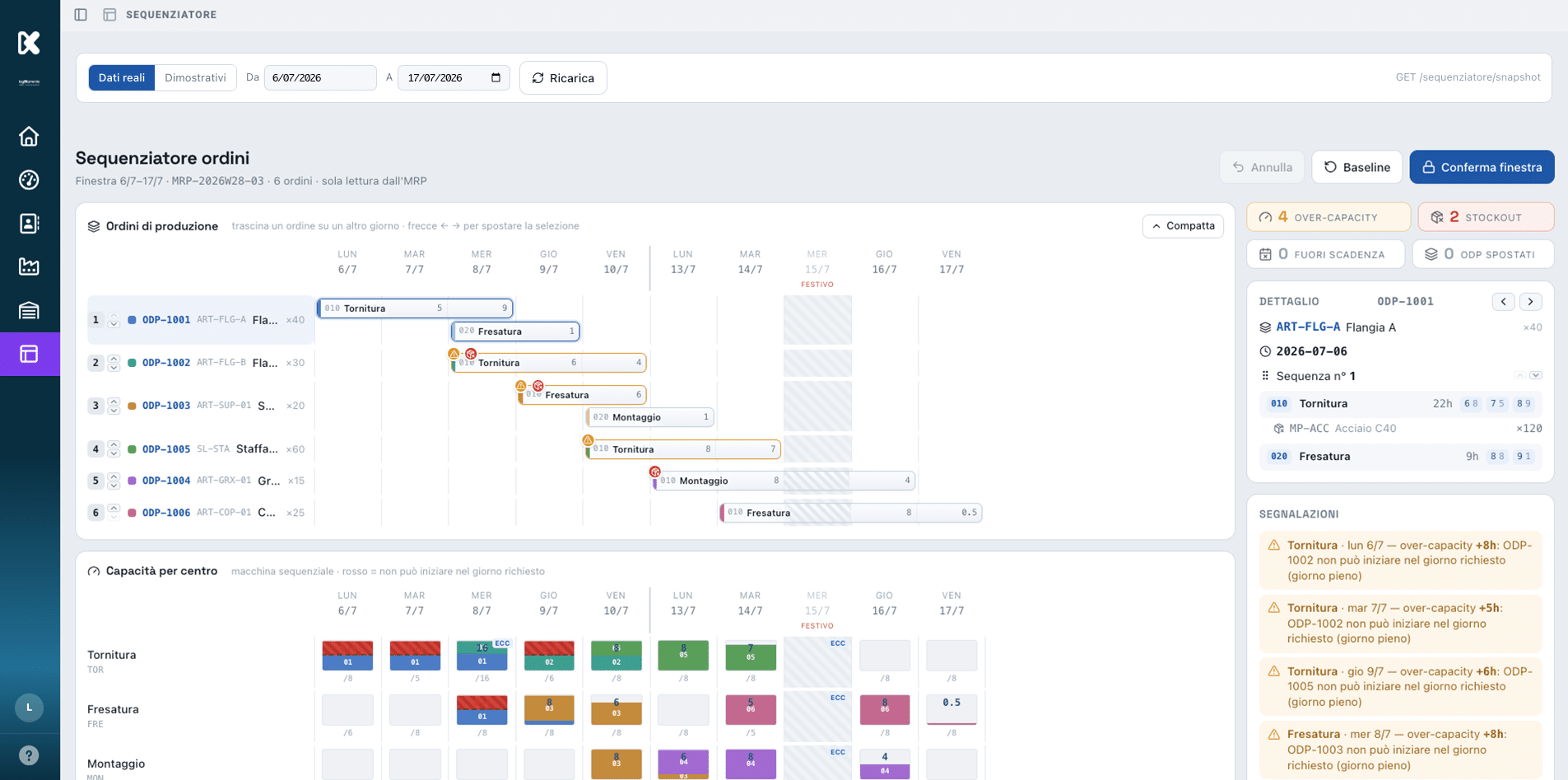
The planner stays in control: they can simulate alternative sequences before confirming them and intervene manually on the plan when needed.
Which KPIs measure the quality of the production sequence
- On-time delivery (OTD): percentage of orders completed by the planned date. It is the first indicator to watch when you change the sequencing rule.
- Average and maximum lateness: these measure how late the late orders are. Read together with OTD, they distinguish a few serious delays from many minor ones.
- Average throughput time: from order release to completion. It is directly linked to WIP.
- Schedule adherence: share of orders carried out in the planned sequence. A low value indicates that the shop floor does not find the plan credible.
- Total setup time: essential where setups depend on the sequence.
- Resource utilisation: actual use of the available capacity, to be read together with OEE.
Conclusions
The production sequencer is the point where the plan becomes real work on the machine. It is also the point where, with the same capacity, you decide which orders will be delivered on time.
Leaving sequencing to individual experience means accepting results that vary and are hard to explain. Managing it with explicit logic, integrated with the warehouse and shop-floor tracking, makes delivery dates predictable and the effect of every choice measurable.

He is often the first person you meet when you get in touch with us. His job is to listen: to understand how the company works, where time is lost, and what the people on the shop floor and in the office need. From there he helps choose the digital tools that fit the process, without adding anything that isn't needed.