 Italiano IT
 English EN
 Français FR

Production planning software lets companies coordinate resources, materials and production capacity, supporting both strategic and operational decisions. In this scenario, the role of the production planning manager becomes central, as does the adoption of production planning software able to support analysis, simulation and dynamic replanning.
What is production planning?
Production planning is the process through which a manufacturing company defines production volumes, timing and methods based on forecast demand and available resources. It sits at a medium-to-long-term decision level and aims to balance production capacity, material availability and customer service levels.
Planning is not only about deciding the volumes to produce: it is part of a broader production planning and management process, which includes:
- Demand forecasting
- Inventory management
- Procurement
- Coordination of production departments
The key stages of planning
The stages of production planning follow a logical sequence that turns demand forecasts into a production plan that is sustainable and consistent with the company's constraints.
Demand analysis and forecasting
This stage covers the collection and analysis of demand data based on:
- Sales history
- Orders received
- Sales forecasts
- Market trends
An accurate forecast is essential to avoid overproduction or shortages of finished goods.
Assessing production capacity
In this stage the available production capacity is checked, taking into account:
- Plant production capacity
- Labour resources
- Technical and maintenance constraints
The aim is to check that forecast demand and actual capacity are consistent, and to identify any critical issues.
Defining the production plan
The production plan is the heart of the planning process. It defines:
- Production volumes per period
- Product mix
- Production priorities
This stage is often coordinated by the production planning manager, who must keep strategic objectives and operational constraints aligned.
Planning materials and resources
The plan is translated into material and component requirements using MRP logic, making sure the necessary resources are available at the right time.
KPI monitoring
Production planning requires continuous monitoring through specific production planning KPIs, including:
- Service level
- Plan adherence
- Resource utilisation
- Inventory turnover
Analysing KPIs makes it possible to step in promptly with replanning when deviations occur.
The benefits of production planning
Structured production planning based on reliable data is a fundamental element for manufacturing companies, because it creates the conditions for a more efficient and consistent organisation of production processes.
With a planned approach, it is possible to coordinate resources, machines and materials better, anticipate problems and make informed decisions.
This approach not only makes production flows easier to control, it is also the basis for optimising time, cost and quality, giving companies greater predictability and the ability to react to changes in demand or unexpected events.
The concrete benefits of accurate planning are described in detail below.
Optimised resources
Planning allows plant, labour and materials to be used more efficiently, reducing inefficiencies and idle time.
Lower costs
With better visibility of requirements, it is possible to:
- Reduce stock
- Limit production emergencies
- Contain operating and logistics costs
Better operational performance
Monitoring production planning KPIs improves production continuity, delivery reliability and customer service quality. Planning integrated with operational systems makes it possible to react quickly to changes in demand or unexpected production issues, making the company more resilient.
The difference between production planning and production scheduling
The distinction between production planning and production scheduling is fundamental to understanding how production processes are organised.
Production planning works over a medium-to-long time horizon, defines what and how much to produce and works on product families, whereas production scheduling has a short-term horizon, defines how and when to produce and assigns orders, resources and operation sequences. In today's industrial context, the two processes are closely linked and are often managed together through advanced production planning and scheduling systems.
Tools for effective planning
The growing complexity of processes makes manual planning ineffective. This is why many companies adopt dedicated production planning software.
Production scheduling software
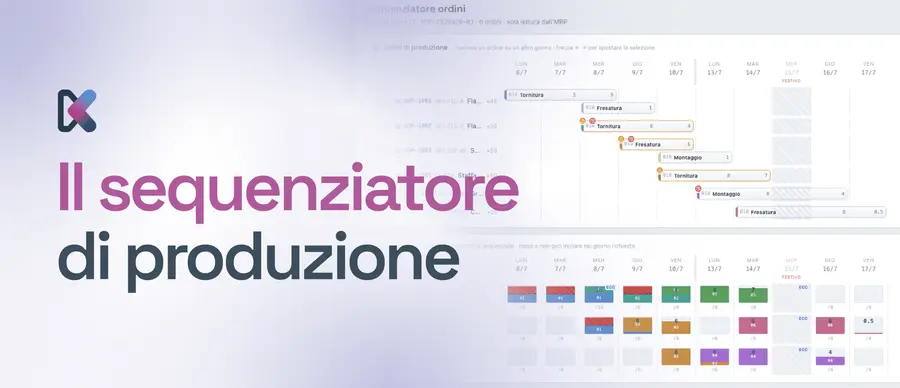
Scheduling software is an advanced solution for the operational management of production, focused on advanced scheduling features. It allows finite-capacity planning, taking into account the real availability of production resources.
It supports the simulation of alternative scenarios to assess the impact of different operational choices. It handles complex constraints related to materials, machines, labour and order priorities. It includes automatic optimisation algorithms to improve the performance of the production system.
In this context, the scheduler turns production plans into consistent, executable operational schedules. It gives the planning manager a decision-making tool based on reliable, up-to-date data, and makes it possible to react quickly to changes in demand and to operational problems.
MES software (Manufacturing Execution System)
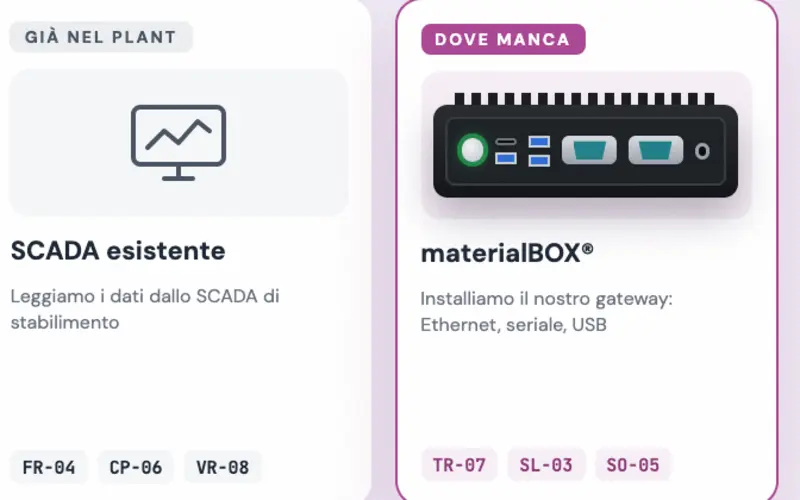
Integration between production planning and scheduling software and MES software is a key element in Industry 4.0 environments.
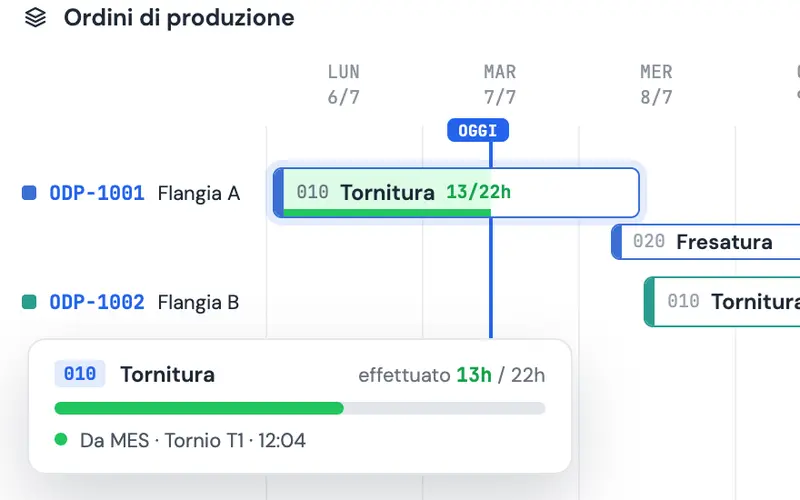
By connecting to real-time data collection platforms, this software acquires up-to-date information on the status of machines, orders and resources. This makes it possible to compare the production plan continuously with actual execution on the factory floor and to spot any deviations quickly.
The scheduler can then update and recalculate operational schedules dynamically, keeping planning and production reality more closely aligned. This approach supports smart manufacturing models based on flexibility, responsiveness and decisions driven by reliable, always up-to-date data.
Conclusions
In conclusion, using planning and scheduling software integrated with real-time data lets companies turn strategic plans into day-to-day operations, increasing efficiency, flexibility and the ability to respond to the unexpected, and making planning a real competitive advantage.

He is often the first person you meet when you get in touch with us. His job is to listen: to understand how the company works, where time is lost, and what the people on the shop floor and in the office need. From there he helps choose the digital tools that fit the process, without adding anything that isn't needed.